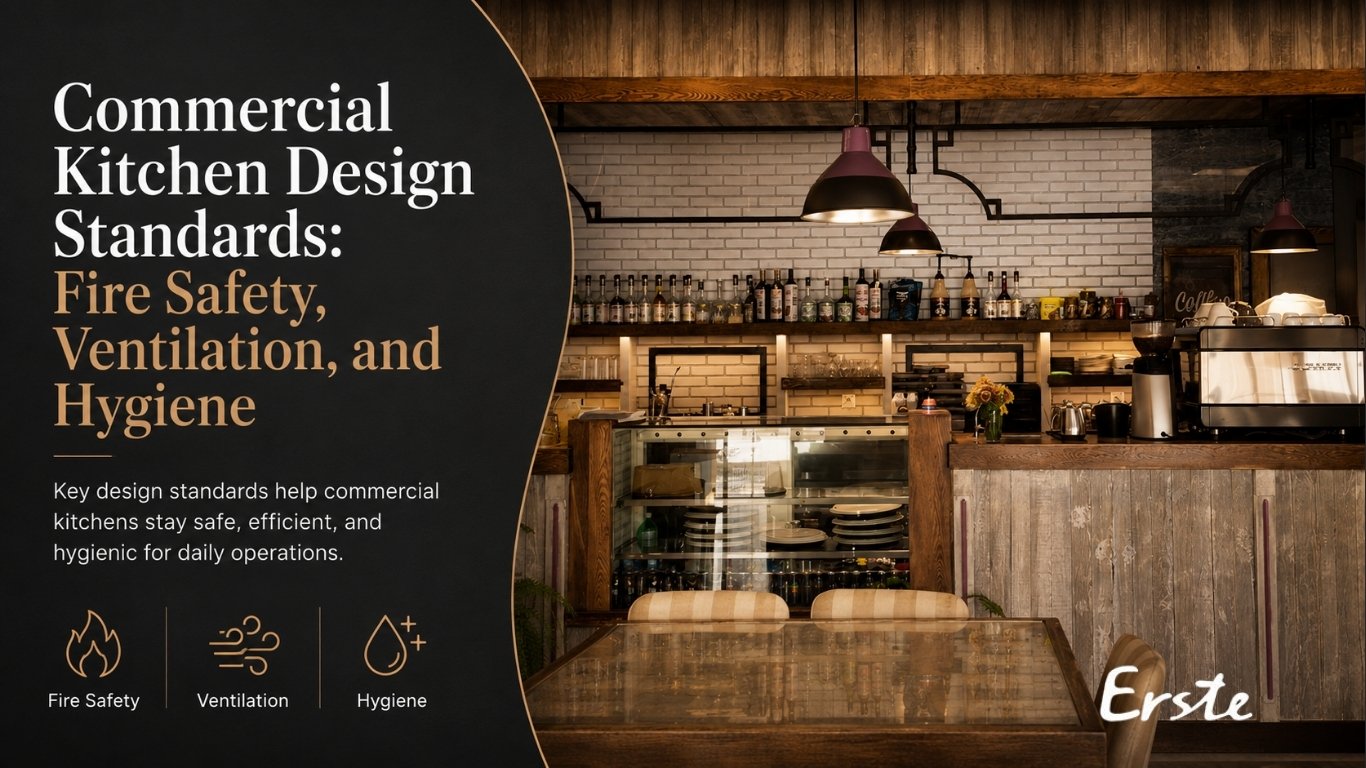
Kitchen design for commercial food service operations is governed by a strict framework of regulations that residential spaces do not face. Whether you are opening a restaurant, café, or ghost kitchen, your kitchen design must satisfy fire safety codes, ventilation requirements, and hygiene standards before you serve a single customer. These regulations are not optional—they are enforced through mandatory inspections by local health, building, and fire authorities. A failure to meet kitchen design standards can lead to costly redesigns, delayed openings, and even closure orders. This guide explains the essential compliance pillars of commercial kitchen design, providing practical knowledge to help you navigate regulations and build a safe, efficient workspace.
Fire Safety: The Non‑Negotiable Core of Commercial Kitchen Design
Fire safety is the most critical component of commercial kitchen design. Cooking equipment that produces grease‑laden vapours—including fryers, grills, ranges, and wok stations—presents a significant fire hazard. NFPA 96, the Standard for Ventilation Control and Fire Protection of Commercial Cooking Operations, establishes the national benchmark for fire safety in commercial kitchens. Any kitchen design that includes grease‑producing equipment must comply with NFPA 96 requirements, which govern hood and duct construction, clearance from combustible materials, and mandatory professional cleaning schedules.
- Type 1 ventilation hoods are required for all grease‑producing equipment. These hoods are engineered to remove heat, smoke, and grease‑laden vapours, and they must be connected to a UL 300‑certified automatic fire suppression system.
- UL 300 certification indicates the suppression system meets modern standards specifically designed to extinguish grease fires, which behave differently from ordinary fires and are resistant to conventional extinguishing agents.
- A dedicated automatic fire suppression system must be installed over all protected cooking appliances. The system typically uses wet chemicals that blanket the fire and cool the grease to prevent re‑ignition.
- Make‑up air systems are required to replace the air exhausted by ventilation hoods, preventing negative pressure that can draw in outside contaminants, slam doors, and compromise combustion efficiency.
In your commercial kitchen design, fire safety also extends to equipment placement. Maintain proper clearance between cooking equipment and combustible materials such as wood, paper products, and certain insulation types. The required clearances vary based on the equipment‘s construction and the presence of heat‑shielding, so always consult manufacturer specifications and local code requirements.
Ventilation: Managing Heat, Smoke, and Air Quality
Proper ventilation in commercial kitchen design serves multiple purposes beyond fire safety. It removes cooking heat, captures smoke and grease particles, controls odours, and maintains acceptable indoor air quality for kitchen staff. The ventilation system must be sized based on the cooking equipment‘s total heat output and the volume of grease‑laden vapours produced during peak operation.
- The canopy hood should overhang cooking equipment by 1.2 to 1.5 times the appliance‘s dimensions on all sides. This overhang ensures that rising vapours are captured before they escape into the dining area or other parts of the facility.
- Capture velocity—the speed at which air moves into the hood—must be sufficient to contain the thermal plume rising from cooking equipment. Undersized ventilation forces staff to work in uncomfortable heat while allowing grease to deposit on ceilings and walls.
- Balanced make‑up air delivery, supplying 80–90% of the air being exhausted, prevents drafts that extinguish gas pilots and keeps the kitchen at a comfortable pressure relative to adjacent spaces.
- In mixed‑use buildings or conservation areas, carbon filtration may be required to control odours before discharge. Electrostatic precipitators and multi‑stage filtration systems reduce grease content in exhaust air, meeting stricter environmental standards.
Poor ventilation planning in commercial kitchen design leads to operational problems beyond compliance failures. Excessive heat reduces staff morale and productivity. Grease accumulation on surfaces creates slip hazards. Persistent odours drive away customers. Investing in correctly sized ventilation from the outset improves both safety and the bottom line.
Hygiene Zoning: Separation of Clean and Dirty Functions
Hygiene zoning is a foundational principle of commercial kitchen design. The physical separation of clean, dirty, raw, and ready‑to‑eat (RTE) preparation areas prevents cross‑contamination and supports safe food handling. The FDA Food Code emphasises the importance of maintaining a logical flow: receiving → storage → preparation → cooking → holding → serving, with dishwashing isolated from food production zones.
- Dedicated handwashing sinks must be accessible and separate from food preparation and warewashing areas. Each sink must supply hot and cold running water (with a minimum temperature of 110°F for hot water), soap, and single‑use towels or an air dryer.
- A three‑compartment sink is required for manual washing of pots, pans, and utensils that are not dishwasher‑safe. The three compartments accommodate washing, rinsing, and sanitising in sequence.
- All surfaces in food contact zones must be non‑porous, durable, and easily cleanable. Stainless steel dominates commercial kitchen design for worktables, shelving, and equipment exteriors due to its resistance to corrosion, impact, and chemical sanitisers.
- Colour‑coded cutting boards and utensils help separate raw proteins from produce and cooked foods. Many health departments mandate specific separation practices for high‑risk operations.
Temperature zoning supports hygiene in commercial kitchen design. Keep cold prep and refrigeration zones isolated from hot production lines. Avoid placing open refrigeration units directly next to ovens or fryers, where waste heat reduces cooling efficiency and shortens equipment life.
Workflow Layout: The Hot‑Cold‑Clean Triangle
Efficient workflow in commercial kitchen design is built around the hot‑cold‑clean triangle—a professional adaptation of the residential work triangle. The receiving dock leads into dry and refrigerated storage. From storage, ingredients move to preparation stations (cold zone). Prepared items then go to cooking stations (hot zone). Finished dishes go to the pass for plating and expediting (hold zone). Dirty dishes return through a separate path to warewashing (clean‑up zone). This flow minimises cross‑traffic, reduces contamination risk, and accelerates ticket times.
- In compact commercial kitchen design, reducing the number of distinct stations often improves throughput. One consultant found that cutting six micro‑stations down to four focused stations—prep, hot line, plating, and dish—increased throughput by 18% in the first month.
- The pass (expo station) should be positioned where expeditors can observe both the hot line and the dining room. In L‑shaped layouts, placing the pass at the corner (the hinge) provides excellent visibility and efficient handoffs.
- Aisle widths must accommodate two staff members passing comfortably while carrying hot pans. Minimum clearances vary by jurisdiction, but 48 inches between parallel workstations is a common benchmark.
- Dishwashing areas should be isolated from food production with negative air pressure if possible, preventing steam and humidity from drifting into prep zones.
A well‑planned commercial kitchen design directly improves staff safety. Reducing the number of steps cooks take between stations lowers the risk of collisions, spills, and burns. Clear pathways allow staff to move predictably, even during peak rushes.
Documentation and Compliance
Every commercial kitchen design project requires documented compliance with applicable codes. Before construction begins, submit detailed plans to local authorities. During construction, schedule inspections for mechanical (ventilation), plumbing (sanitation), and fire suppression systems. Before opening, coordinate a final inspection with the health department. Maintain records of professional hood cleaning (typically required quarterly or semi‑annually depending on cooking volume), fire suppression system servicing, and equipment certifications.
erste has delivered compliant commercial kitchen design solutions across multiple food service sectors. See our completed commercial projects: https://www.erste.com.hk/our-work/
Need professional guidance on commercial kitchen design standards? Contact unsere team today: https://www.erste.com.hk/contact/